
The Advisory edition
Client management, supervision and Consumer Duty evidence in one system
The Advisory edition is a multi-tenant wealth management platform with an embedded regulatory technology layer. It provides advisers with a complete client book, compliance functions with firm-wide management information, and senior management with a hierarchical view of outcomes across the organisation — from a single data set and a single audit trail.
One data set, three audiences
Client-facing wealth management, adviser workflow and compliance oversight are served from the same records. The management information a compliance function reports on is the same data an adviser is working in, so there is no reconciliation step and no separate compliance database to keep current.
Role determines visibility
Access is derived from the relationships held in the platform: an adviser sees only the clients they are engaged with, a compliance manager sees the firm, and a manager in the reporting hierarchy sees their subtree. The audit log is restricted to the compliance function alone.
Evidence is a by-product
Board reporting, supervisory evidence packs and the vulnerable customer register are generated from the record of work already done. Nothing has to be assembled retrospectively for a board meeting or a supervisory request.
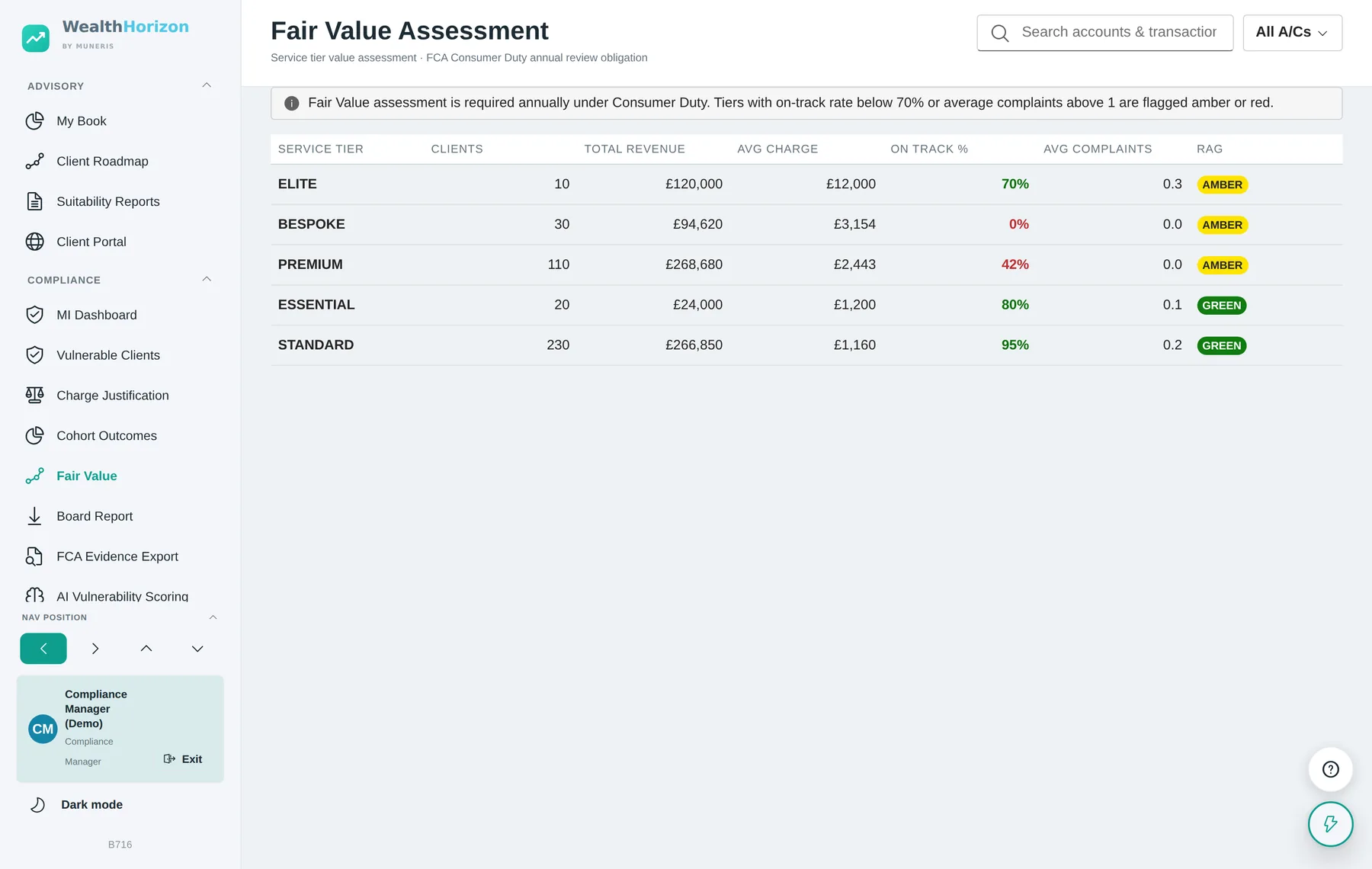
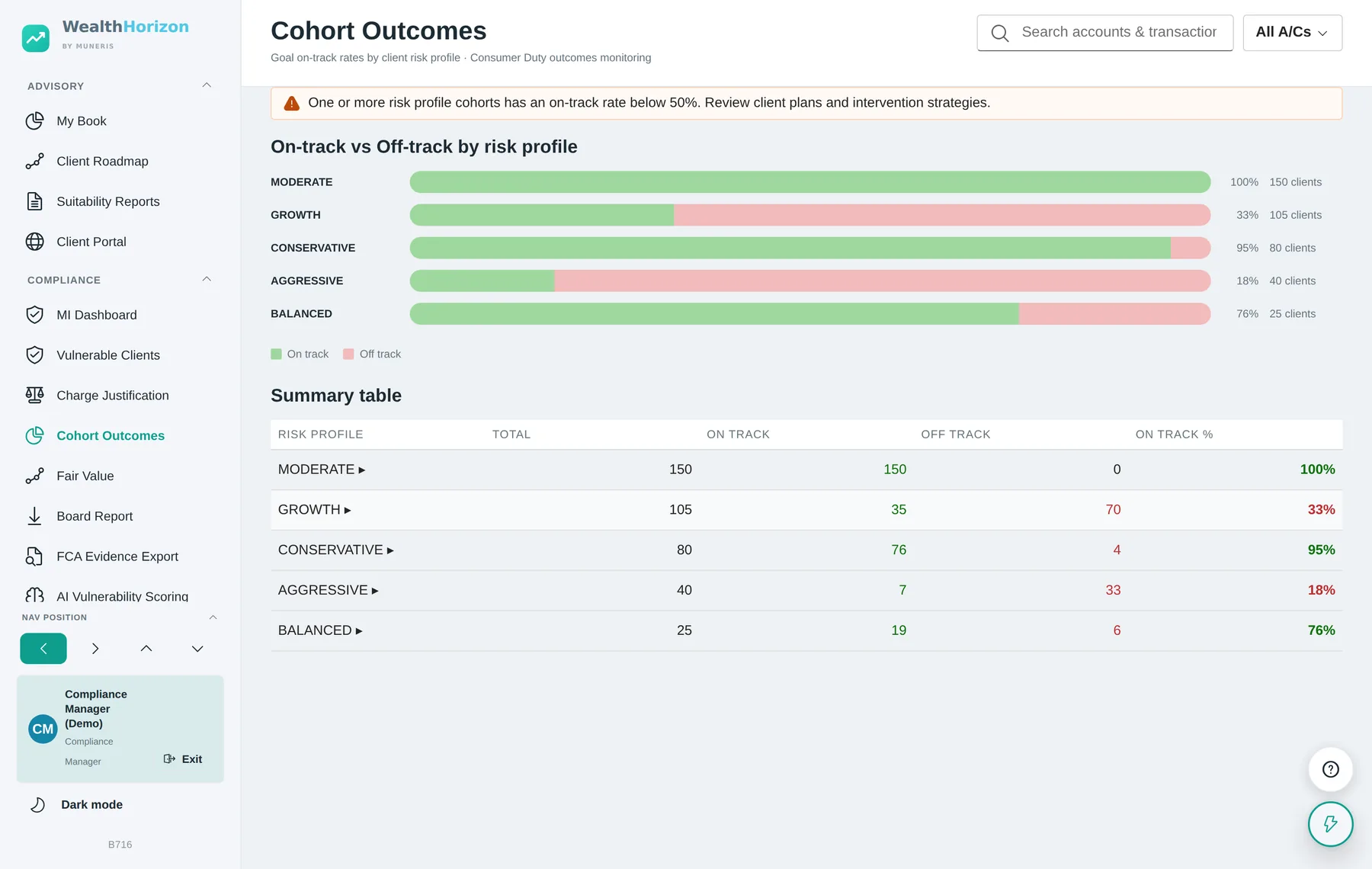
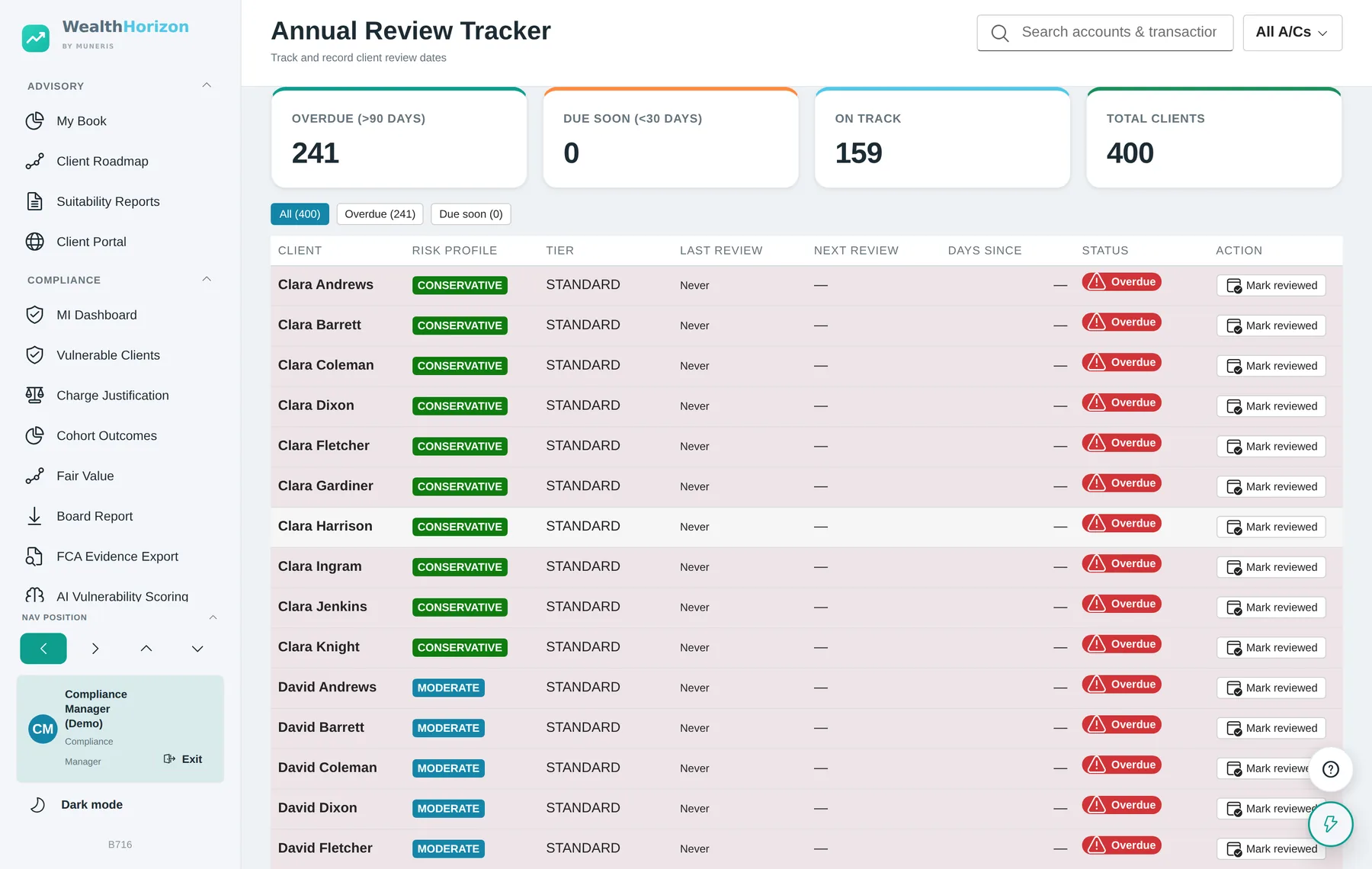
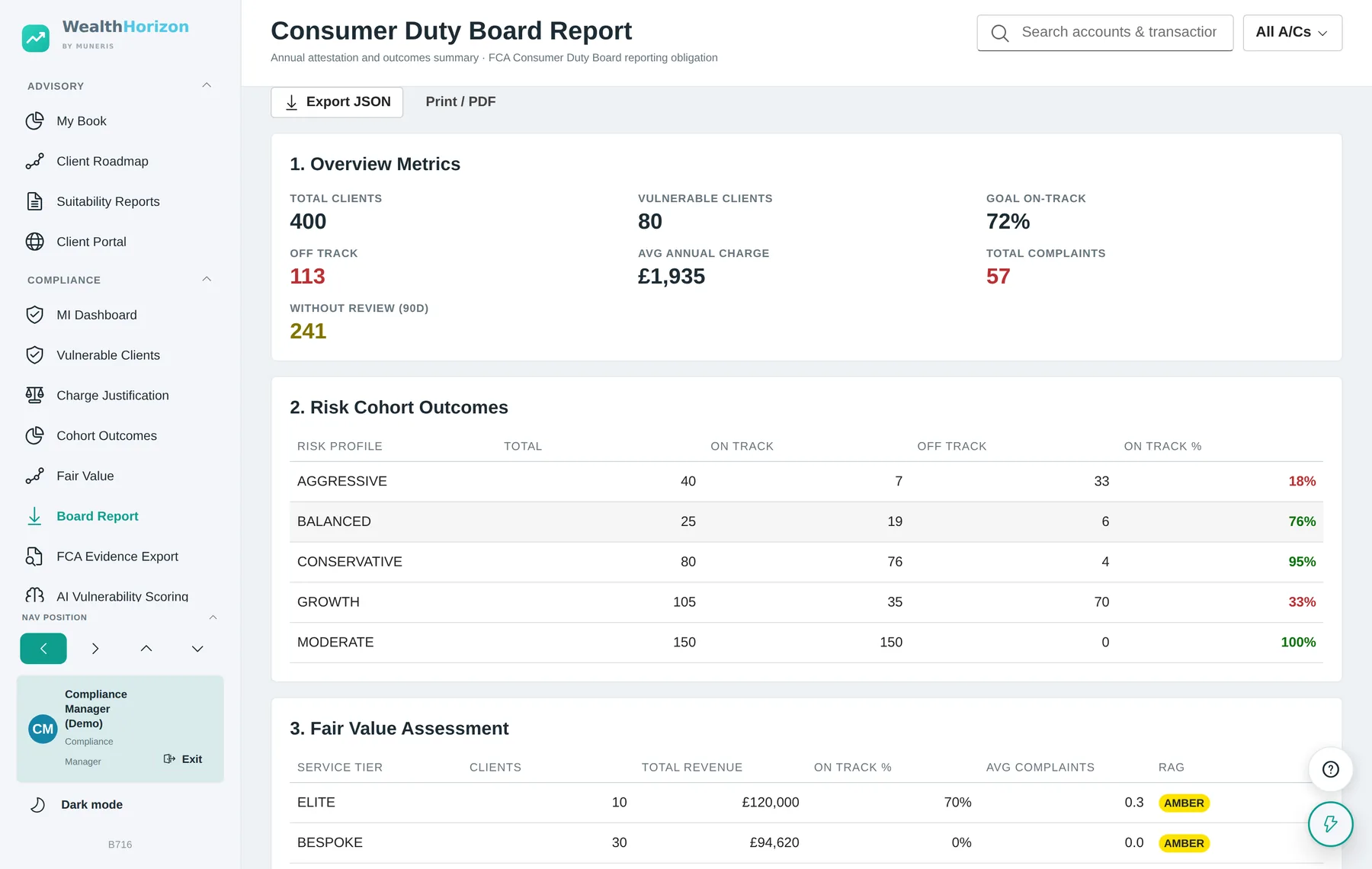
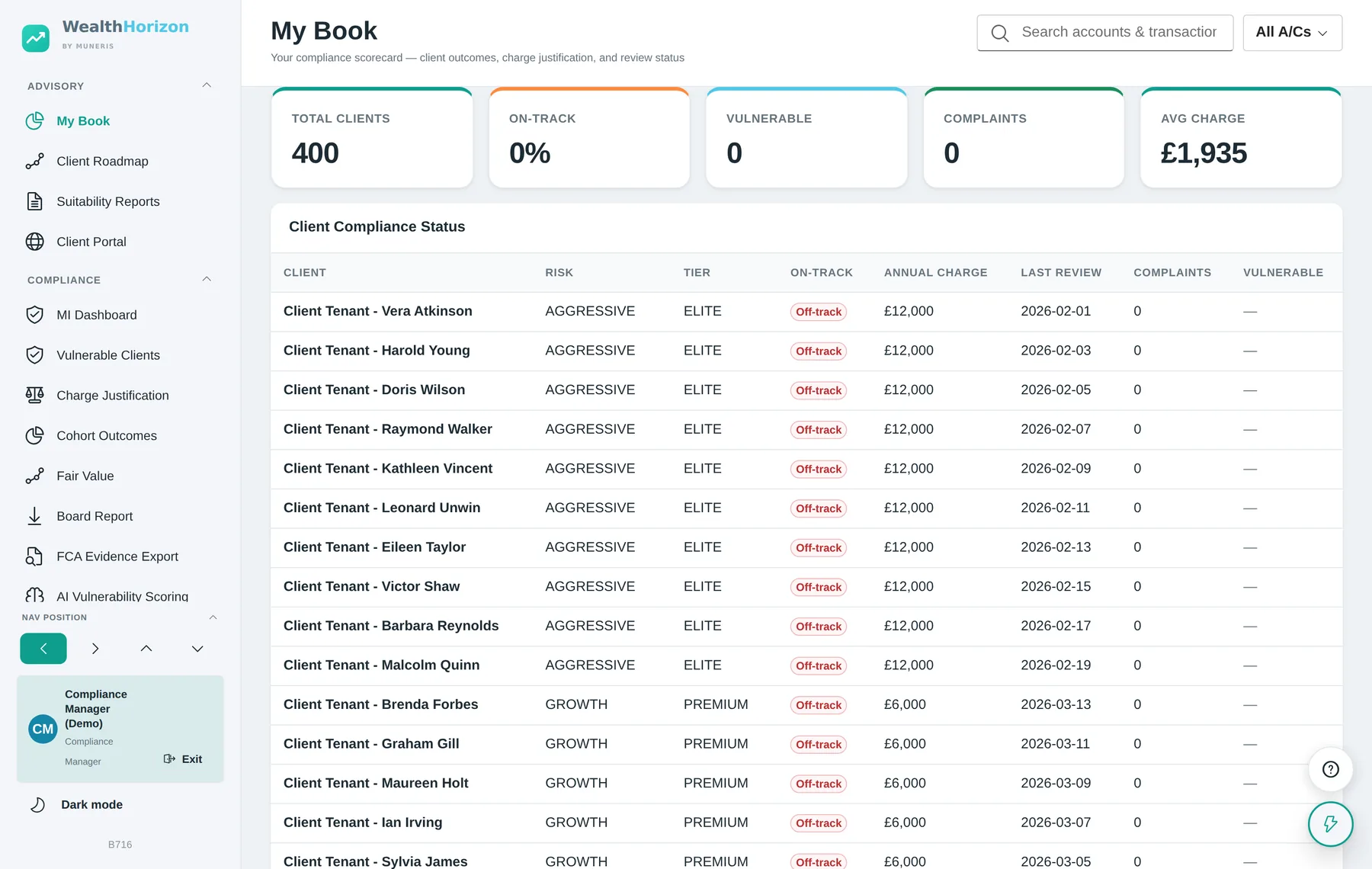
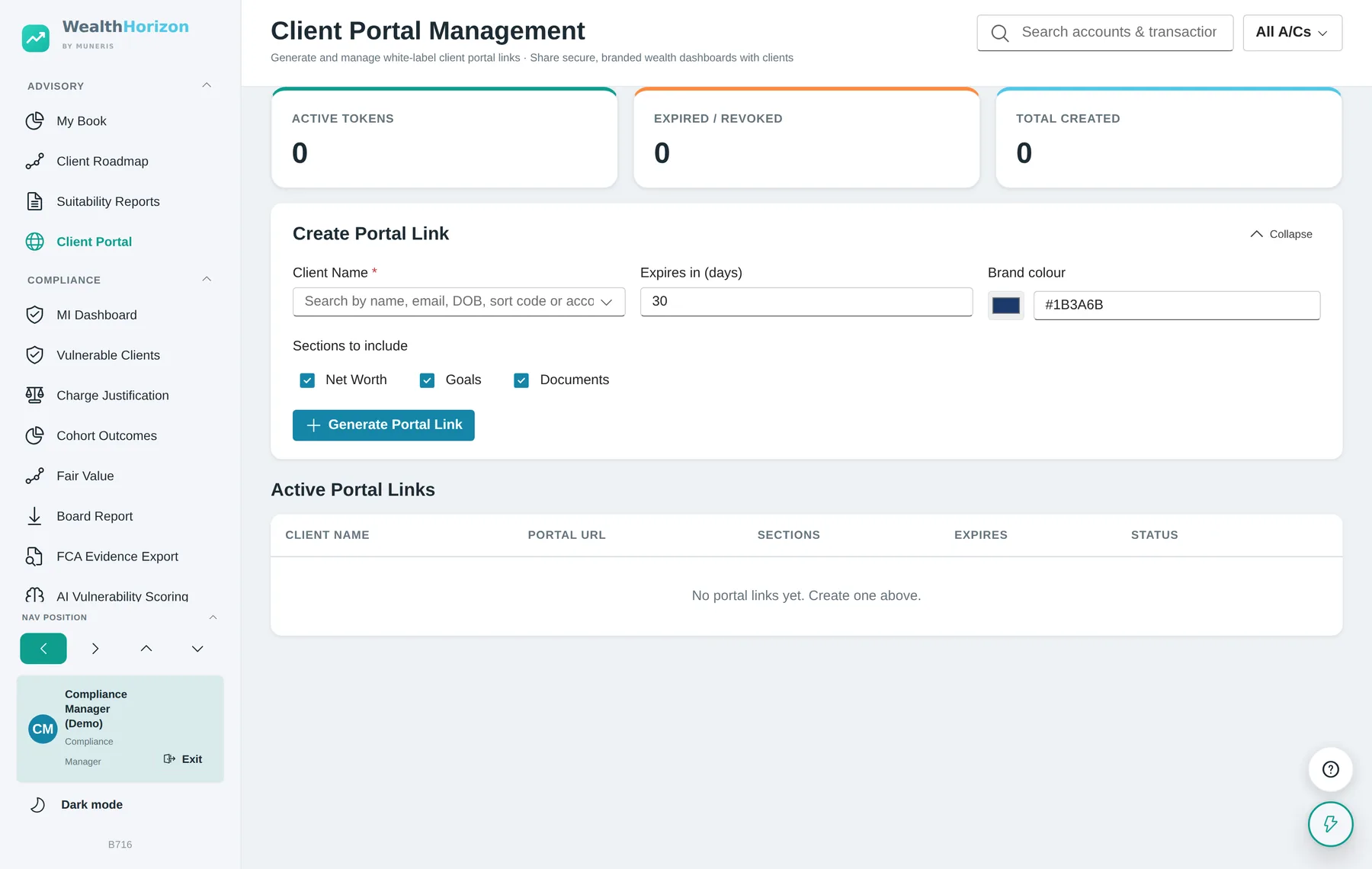
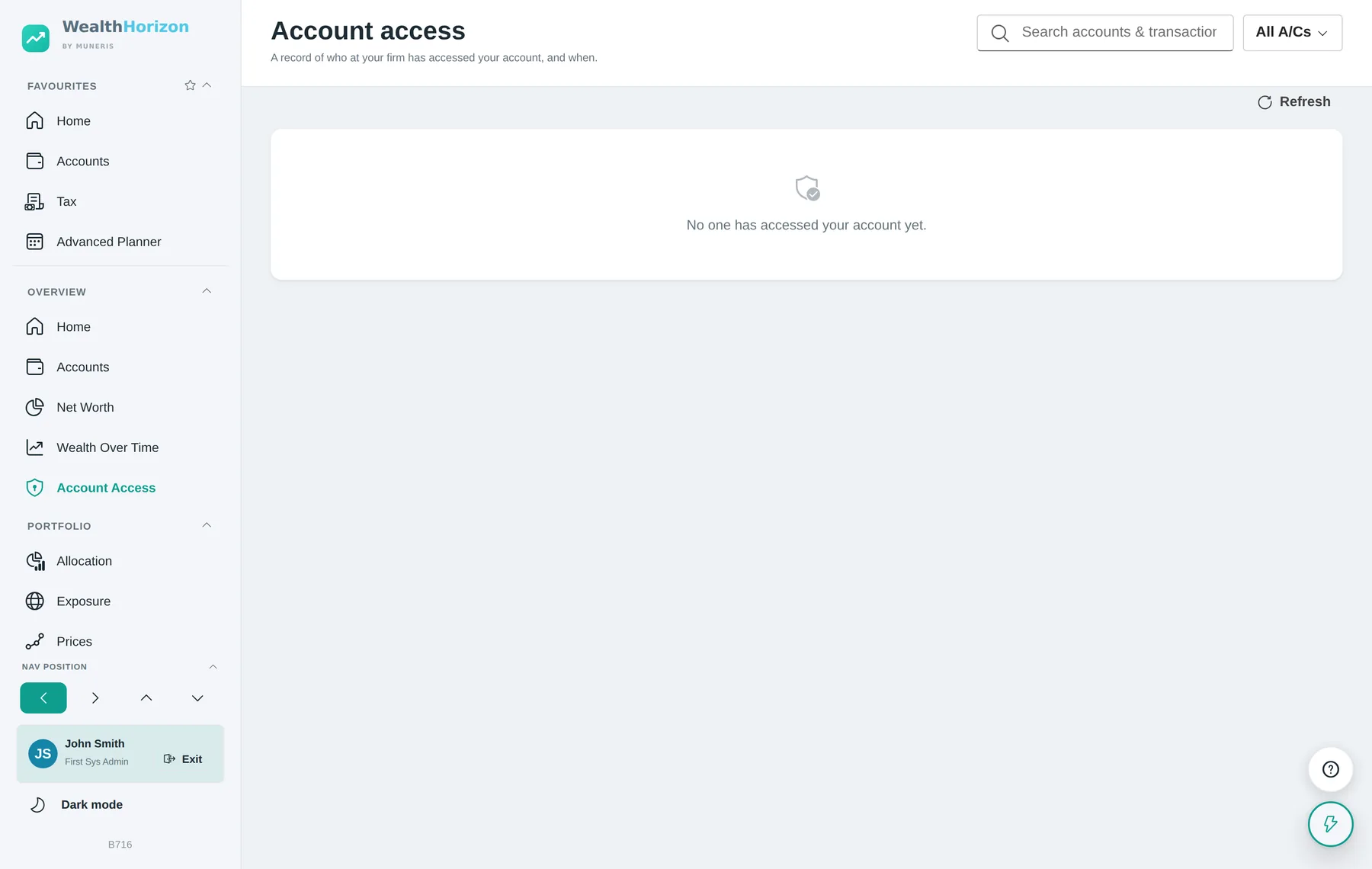
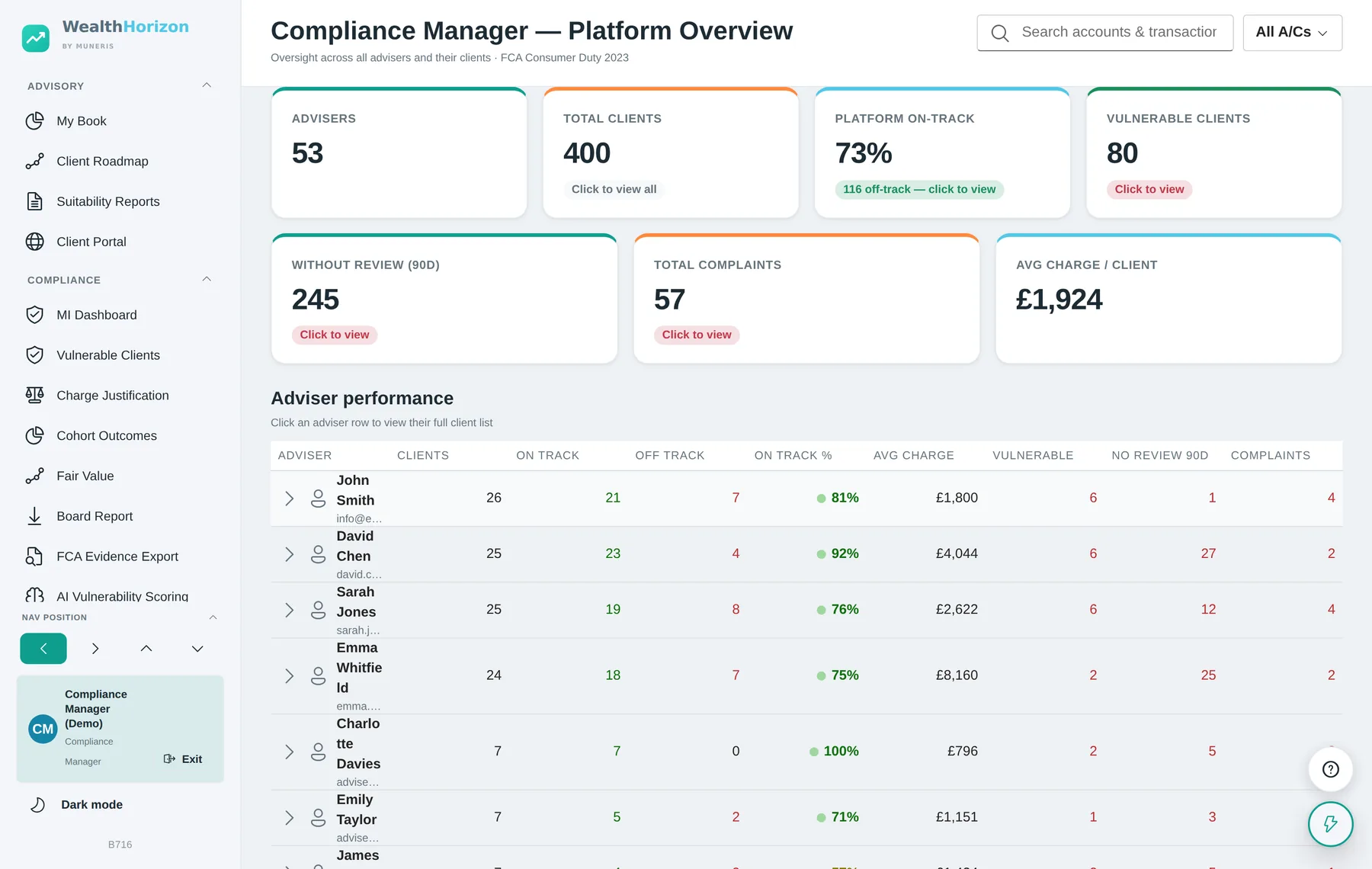
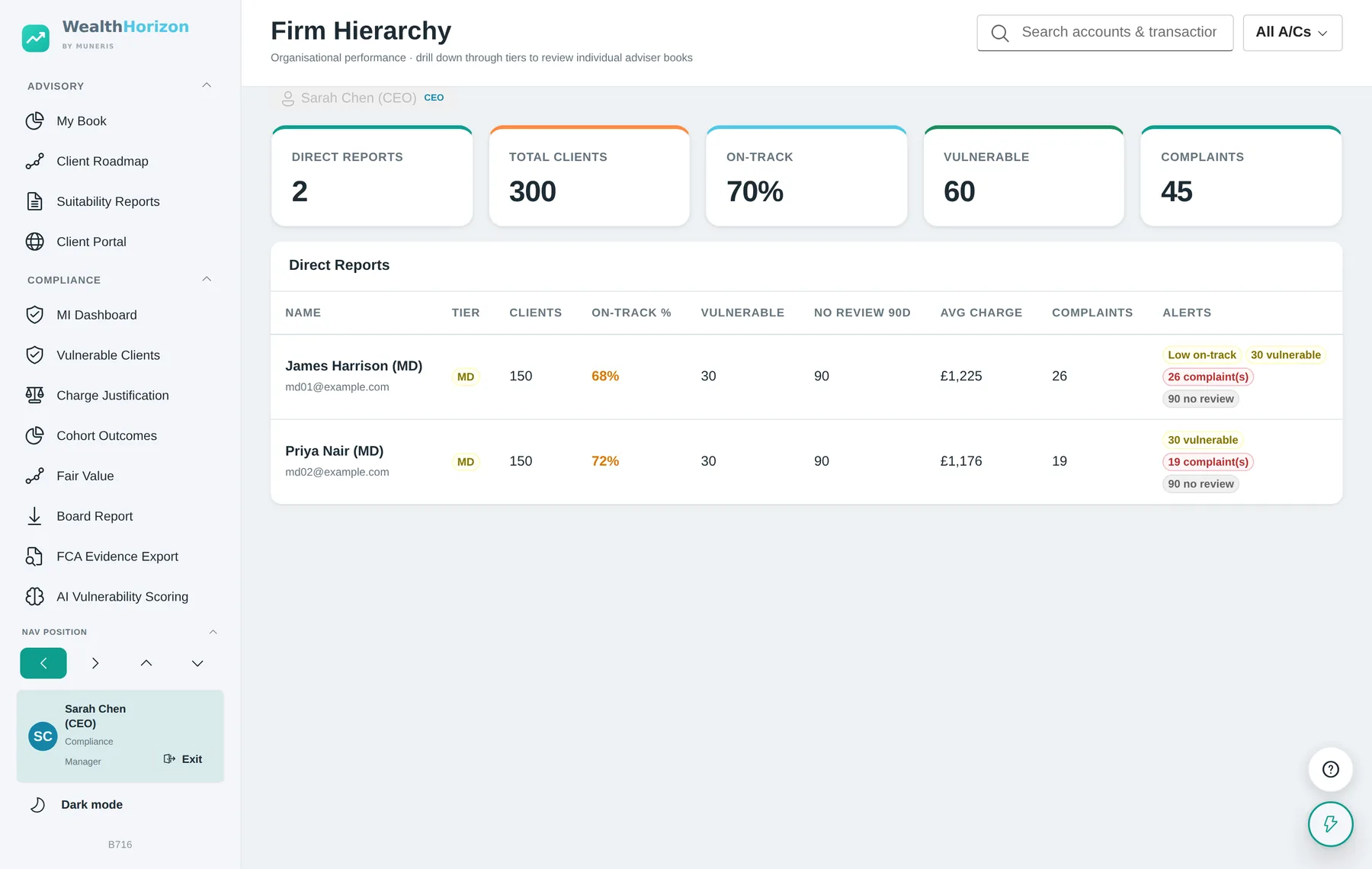
About the screenshots on this page. Every image is the running application, captured from a demonstration environment. Client names, figures, vulnerability flags and complaint counts are fictitious and are provided for illustration.
Regulatory coverage
FCA Consumer Duty — the four outcomes, module by module
The Consumer Duty requires firms to deliver good outcomes, to monitor whether they are being delivered, to act where they are not, and to evidence all three to their board and to the regulator. Each module below maps to an obligation and produces a durable record.
| Outcome | Module | What it produces |
|---|---|---|
| Products and services | Cohort Outcomes | On-track and off-track rates by risk-profile cohort, with drill-down to the individual clients behind each figure and a warning where a cohort falls below a 50% on-track rate. |
| Annual Review Tracker | Overdue, due-soon and on-track counts; a review recorded against the client with the next one scheduled at 6, 12, 18 or 24 months. | |
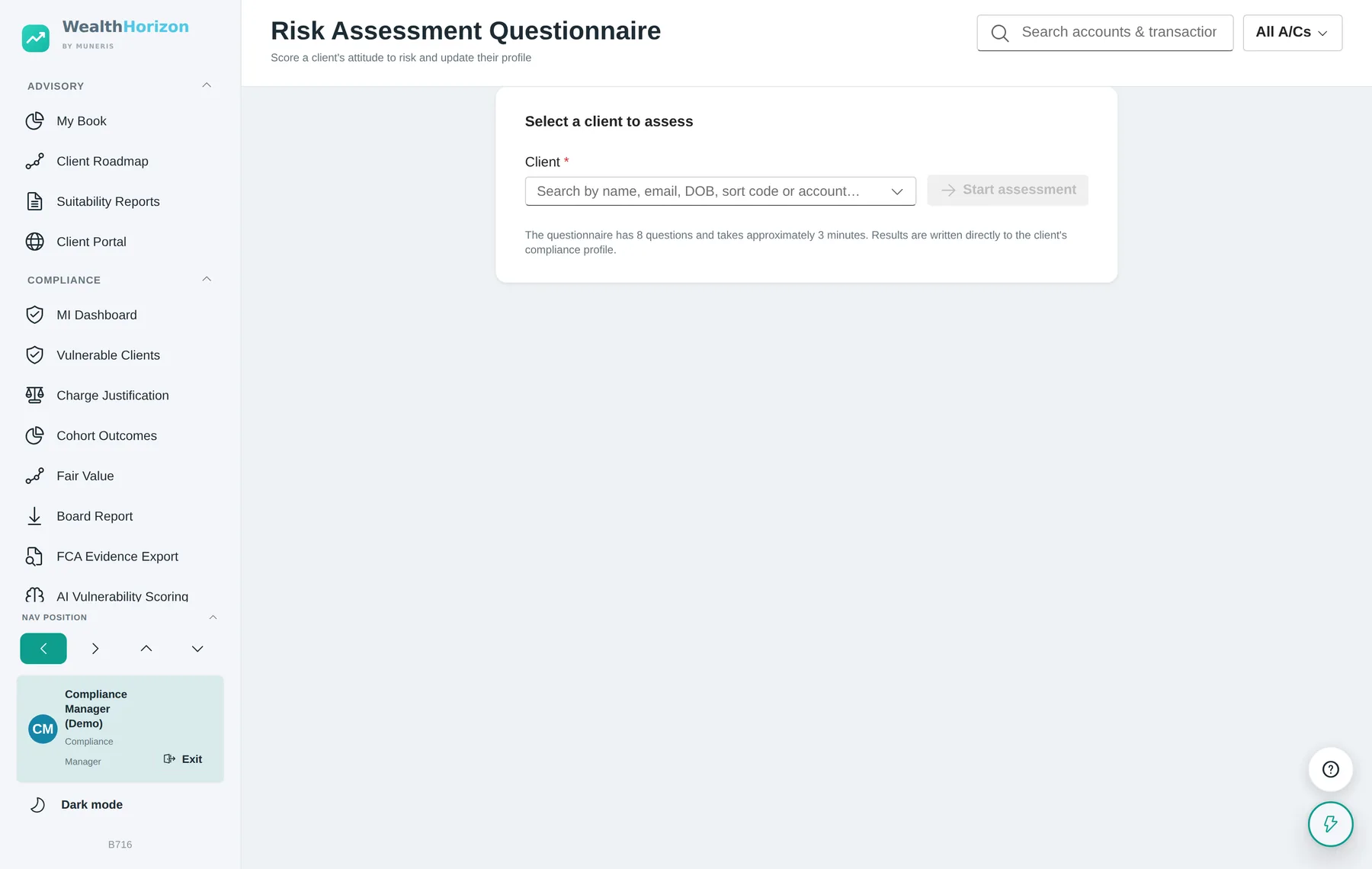
| Risk Assessment | An eight-question attitude-to-risk profile with a stated capacity for loss, written to the client’s compliance record and carried into suitability reporting. | |
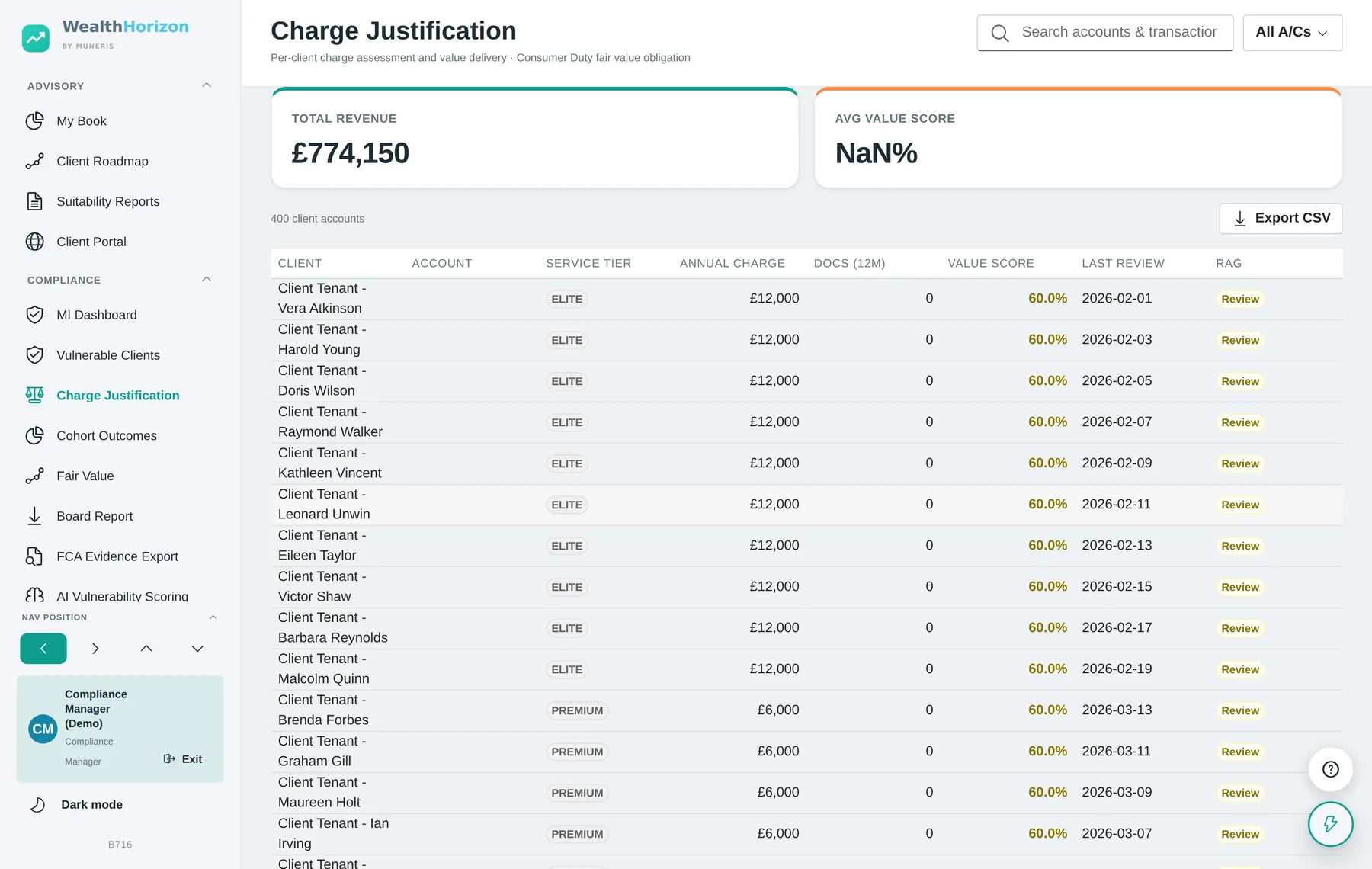
| Price and value | Charge Justification | Per-client service tier, annual charge, deliverables in the last twelve months, a computed value score and a red/amber/green status. Exportable to CSV. |
| Fair Value Assessment | The annual assessment by service tier: client count, revenue, average charge, on-track rate, average complaints and a RAG rating against stated thresholds. | |
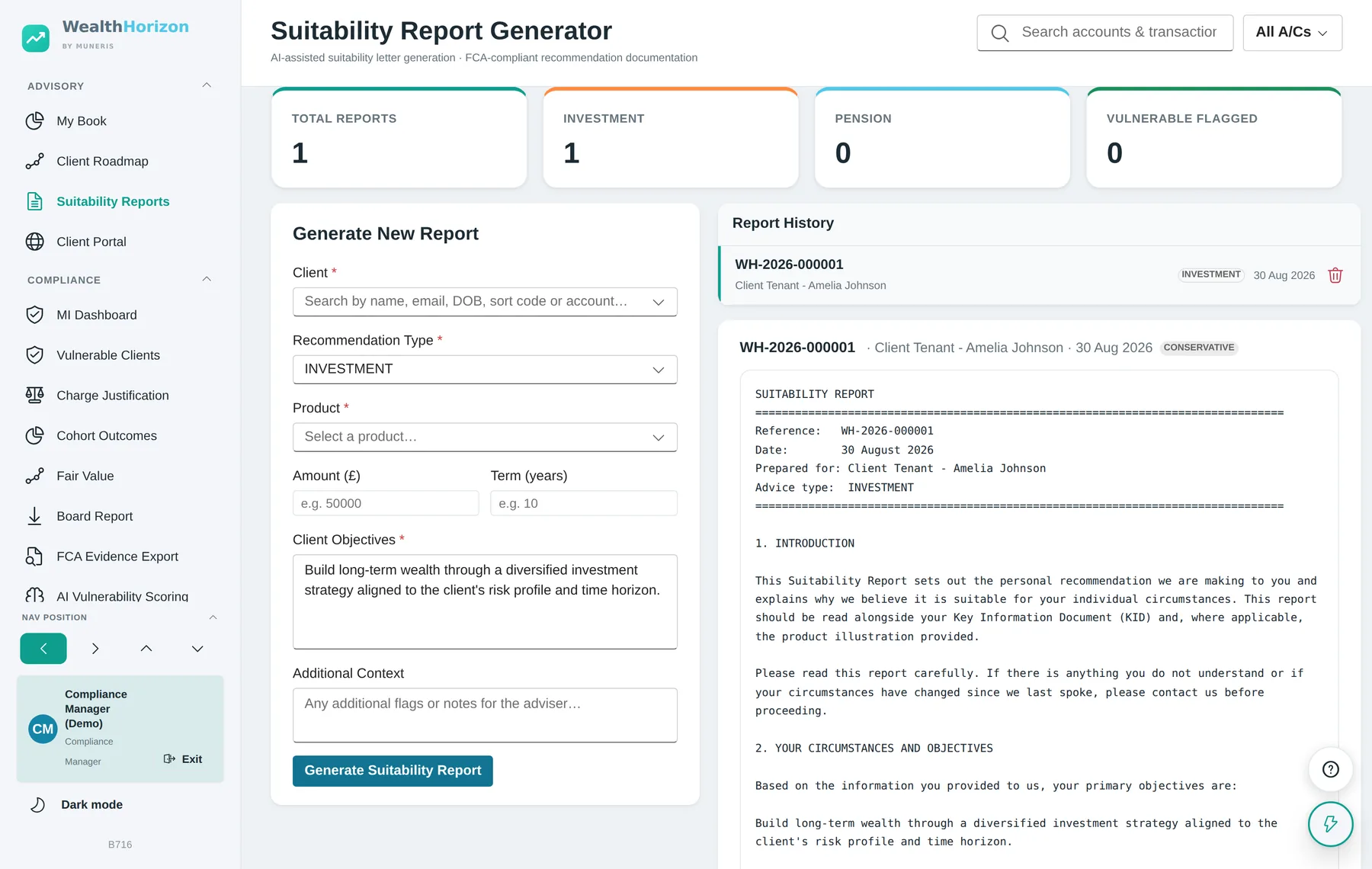
| Consumer understanding | Suitability Reports | A COBS 9.4 suitability letter with a unique reference, drawn from the client’s own circumstances, objectives, risk profile and charges, including risk warnings and alternatives considered. |
| Client Portal | A branded, read-only view of a client’s position, issued on an expiring link and revocable at any time. | |
| Account Access | A client-facing record of who at the firm opened their account, when, and in what role — the transparency side of the same audit trail. | |
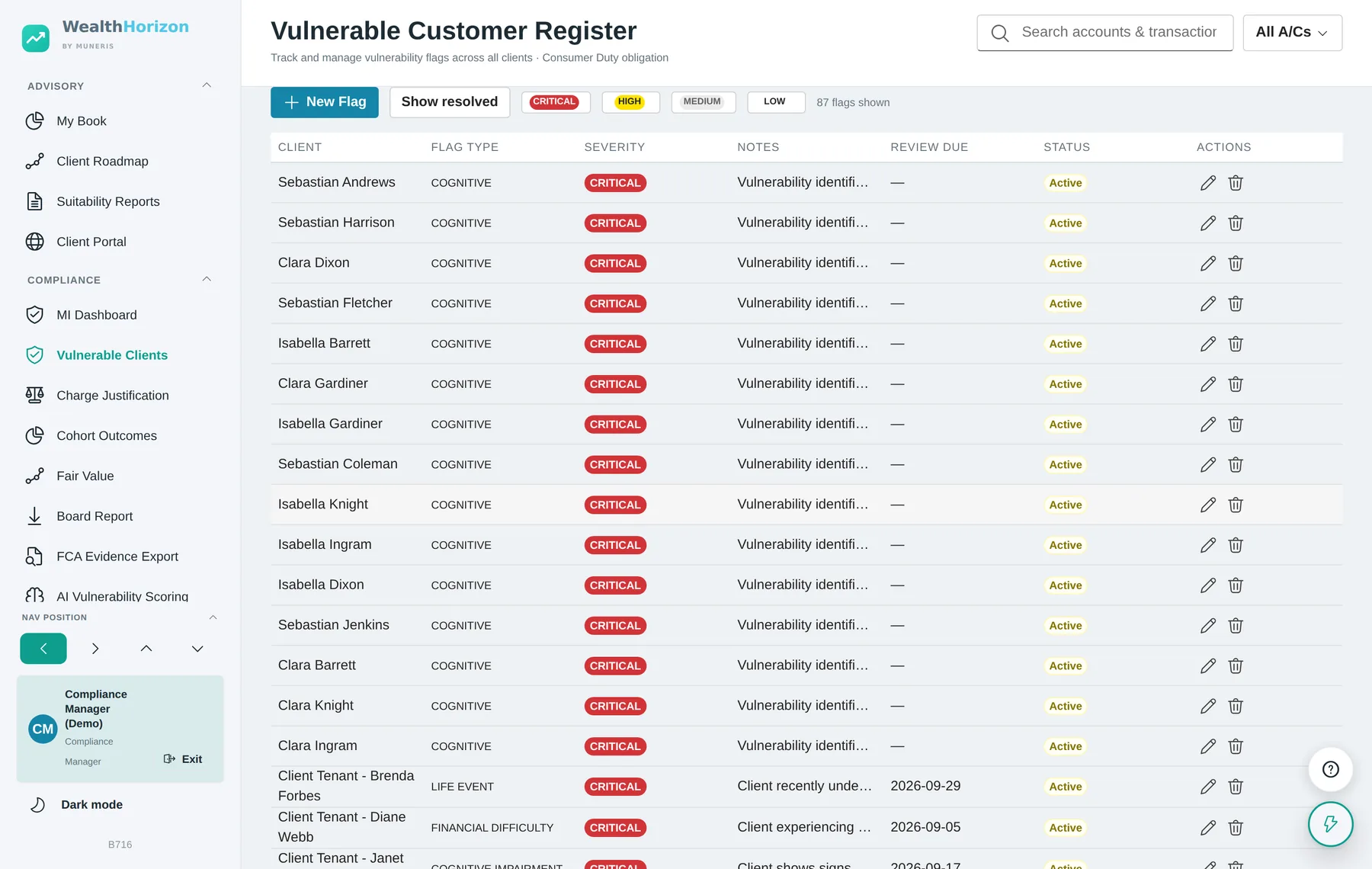
| Consumer support | Vulnerable Customer Register | Flag type, severity, contextual notes, the support actions taken and a review-due date, with an active / reviewed / resolved lifecycle. |
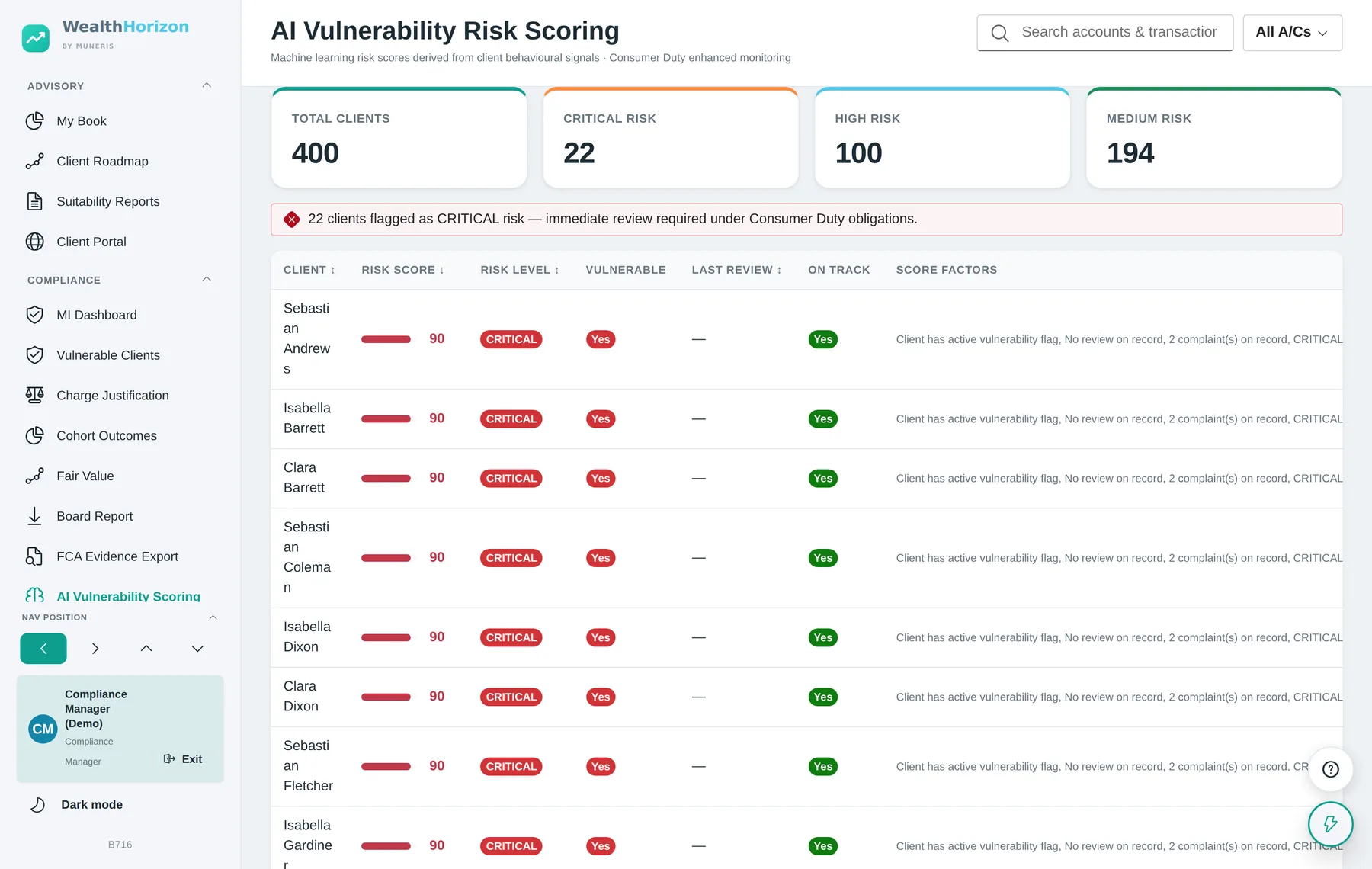
| Vulnerability Scoring | An explainable 0–100 score per client with the contributing factors listed, banded critical, high, medium and low, for prioritisation. | |
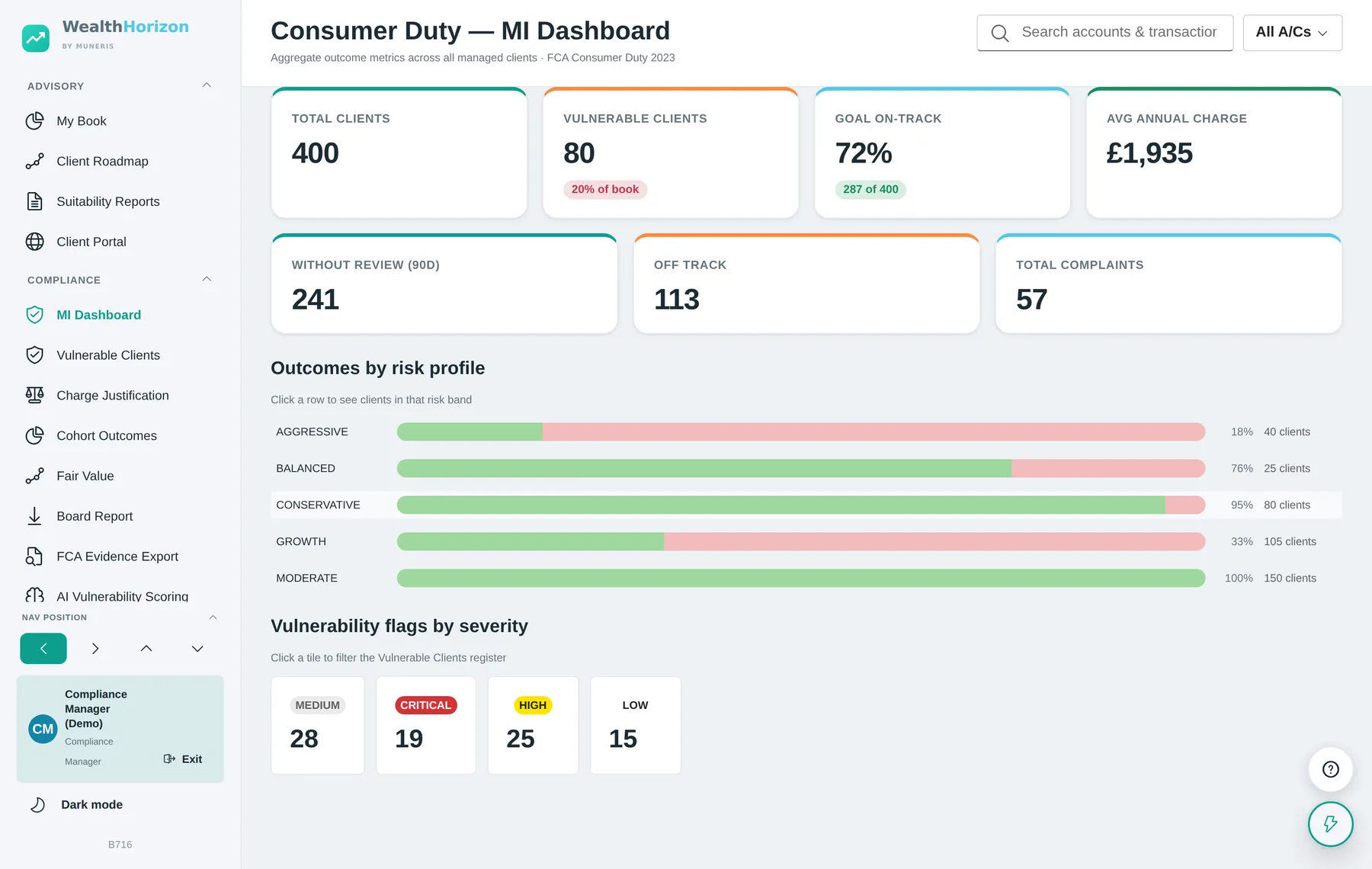
| Governance and monitoring | MI Dashboard | Aggregate outcome metrics across the book, with every headline figure opening the list of clients behind it. |
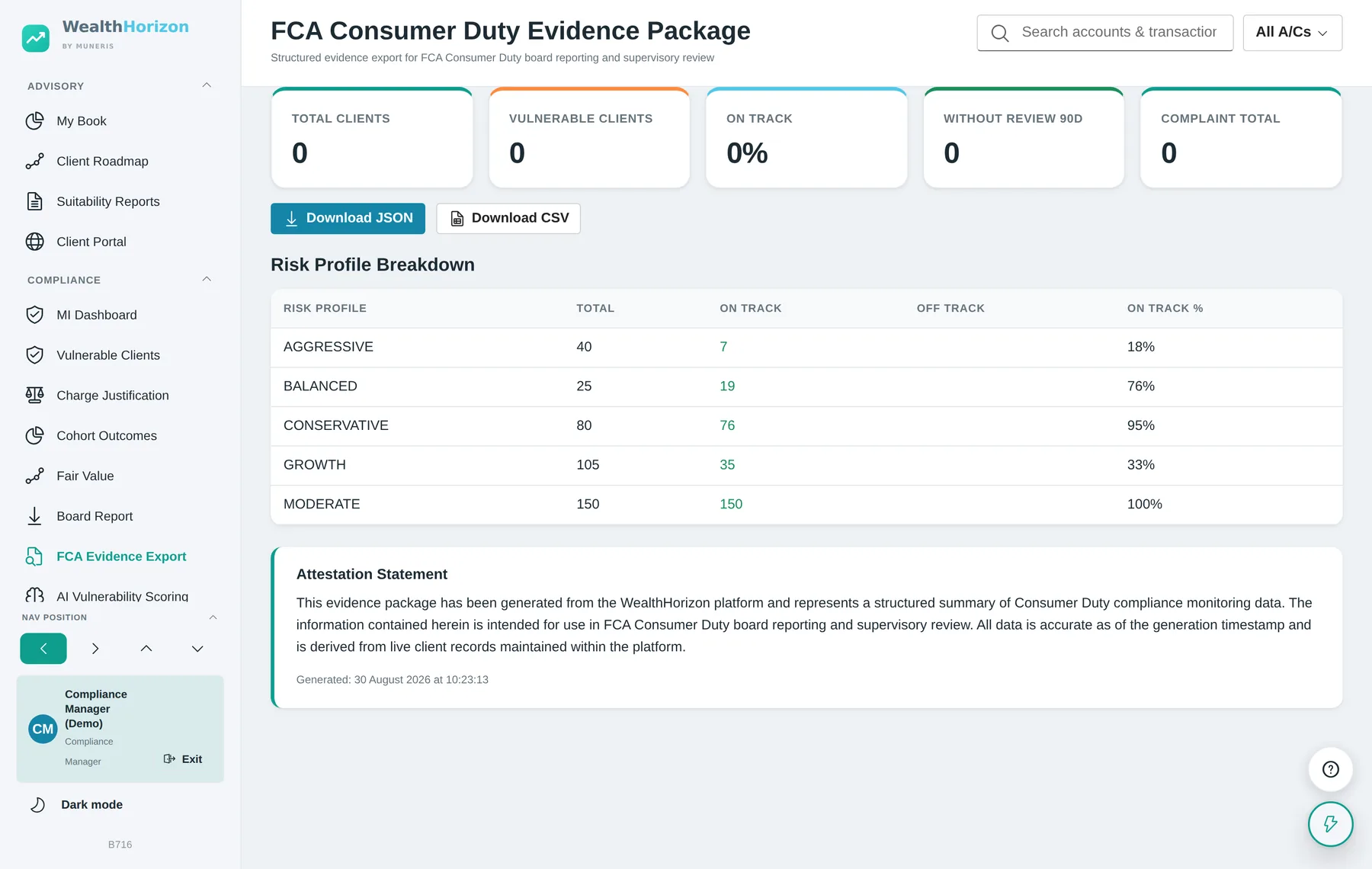
| Board Report | The annual attestation across the four principles, with overview metrics, cohort outcomes and the fair value table, exportable as JSON or printed for the board pack. | |
| FCA Evidence Export | A structured supervisory package over a twelve-month window in JSON, plus a flattened client-level CSV. |
Compliance oversight
Management information that resolves to a named client
A percentage is only useful if it can be turned into a list of people to contact. Every headline metric in the compliance suite is a control: selecting it opens the cohort behind it, and selecting a client from that cohort opens their record.
The advisory desk
The adviser’s working day, with the file written as it goes
An adviser lands on their management information rather than on a client list, because the first question of the day is which clients need attention. From there the workflow runs through the client record, the risk profile, the recommendation and the letter — and each step leaves the evidence the next one depends on.
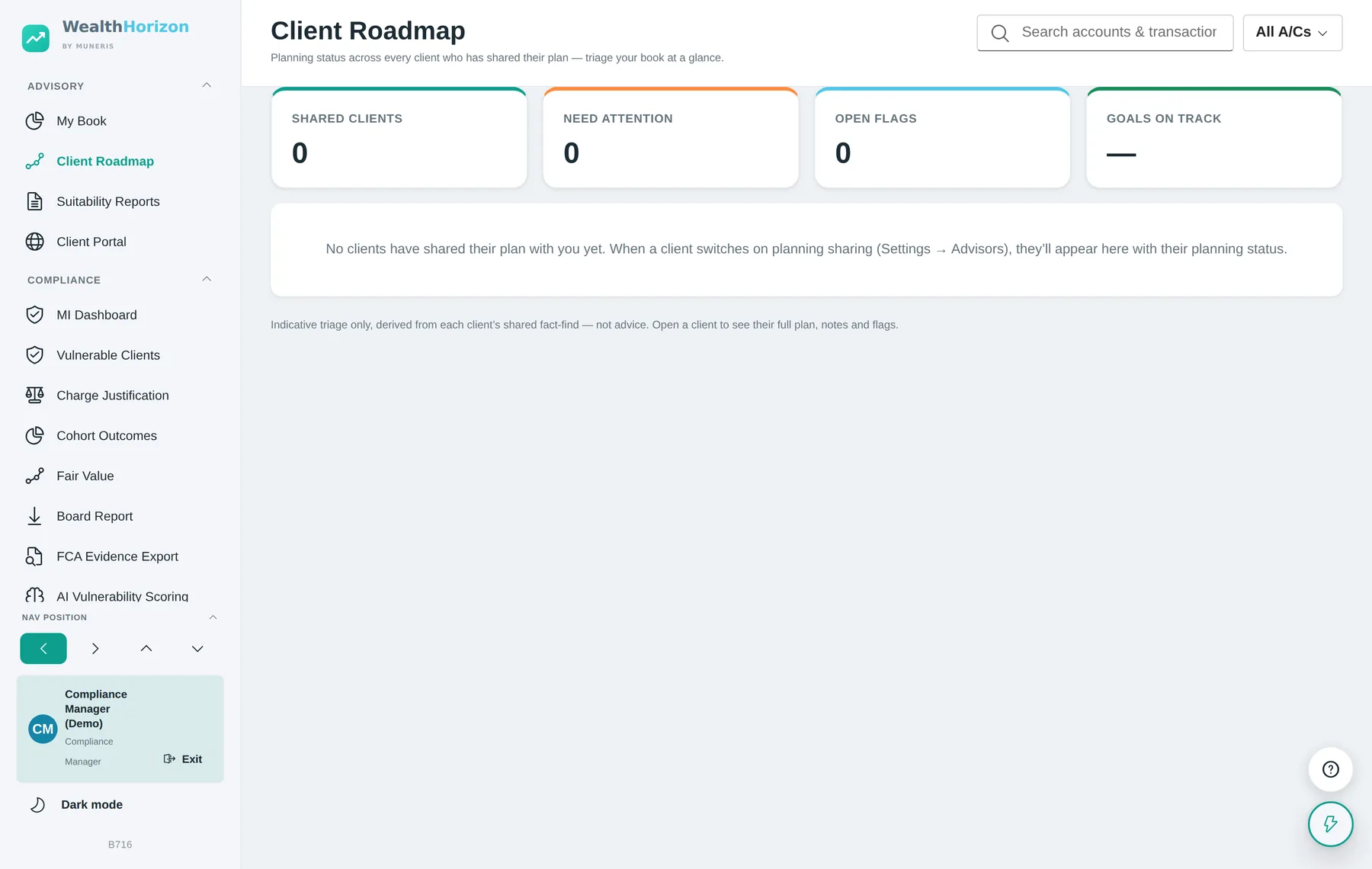
Consent is explicit and revocable. An adviser sees a client’s financial planning fact-find only where the client has switched sharing on. Access is read-only, the client can withdraw it at any point, every read is written to the access log, and switching the consent on or off is itself an audited event. Notes and flags an adviser records against a plan are visible to the client, because transparency is a Consumer Duty expectation rather than an option.
Supervision and firm hierarchy
Two views of the same book: who, and which line of management
Platform Overview presents every adviser side by side, which answers which adviser. Firm Hierarchy rolls the same figures up through the reporting structure, which answers which team, and who is accountable. Together they turn a single amber indicator into a specific conversation with a named manager.
Roll-up, not re-entry
Every figure at every tier is computed from the underlying client records. There is no management reporting layer to populate and no monthly return for advisers to complete, so the numbers a manager reads are the numbers as they stand.
Scoped to the reporting line
A manager’s view is bounded by their own position in the hierarchy: the page opens at their level and shows their subtree. Firm-wide visibility is a compliance function, not a management grade.
Isolated or systemic
A single adviser with a red on-track rate is a conversation. Several advisers under one manager showing amber is a capacity, process or training issue, and the roll-up is what makes the difference visible.
Controls and separation of duties
How access is bounded, and how it is recorded
- Client isolationEach household or client is a tenant, and every record carries its tenant. Queries are scoped to the tenant before any data is returned; a member of staff acting on a client supplies an explicit client context, and the platform verifies the relationship — an active engagement, a compliance role or platform administration — before answering.
- Adviser scopeAn adviser sees the clients they are engaged with and no others. Which of a client’s accounts they may see is granted per account, not per relationship.
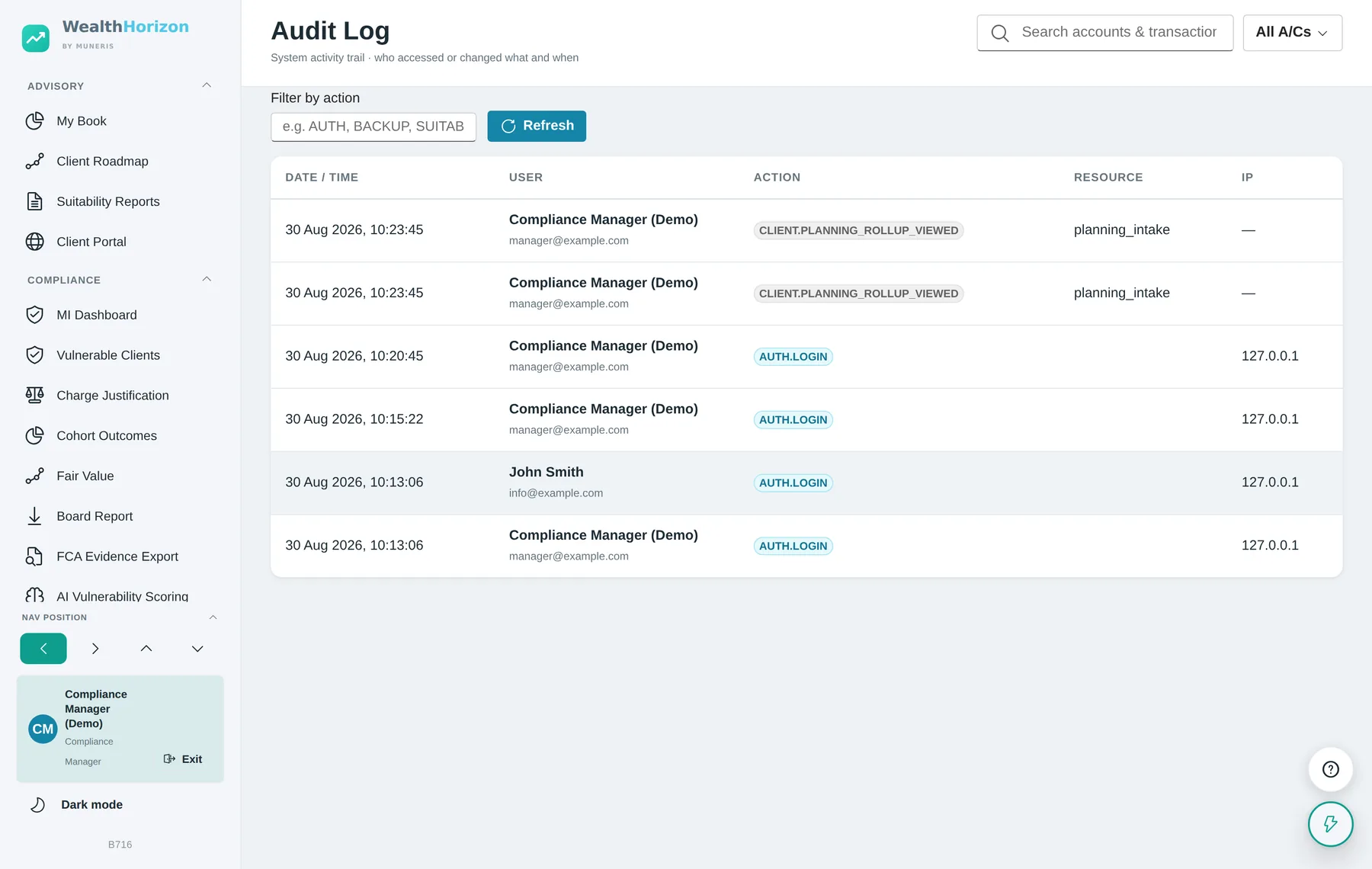
- Compliance scopeA compliance manager has firm-wide visibility of the compliance suite and is the only role that may open the audit log. Every other caller is refused.
- Management scopeA manager in the reporting hierarchy sees their own subtree, derived from the reporting chain rather than assigned by hand.
- Administrative floorThe platform will not permit itself to be left without an active system administrator, and the first administrator cannot be deleted, demoted or deactivated. These invariants are enforced twice — in the application, so the message is useful, and in the database, so a defect or a direct connection cannot bypass them.
- Client record accessOpening a client’s overview is written to the audit log with the actor, the role, the resource and the time. Reading a shared financial plan is a separate, separately consented and separately logged event.
- AuthenticationPasswords are hashed with argon2id under a stated complexity policy. Sessions use short-lived signed access tokens with rotating refresh tokens held only as a hash. Time-based one-time-password two-factor authentication is available per user; a password reset revokes every session on every device.
- Records at restBackups are held inside the database rather than as loose files, may be encrypted with a passphrase using AES-256-GCM, are scheduled with a retention count, and every run is logged.
- DeploymentThe platform runs self-contained on infrastructure of the firm’s choosing — on-premises, in a private cloud or in a public one — which supports data residency and sovereignty requirements without a change to the software.
Scope of the platform’s role
WealthHorizon provides capabilities that support a firm in discharging its regulatory obligations. It does not discharge them. The operating firm remains responsible for its own permissions and regulatory status, for its data protection impact assessment, lawful basis, retention policy and subject access handling, for the accuracy of what it records, and for the advice it gives.
Nothing on this page is legal, regulatory or financial advice. Projections and planning outputs are indicative and depend on assumptions entered by the user. Scoring and prioritisation tools are decision support: they direct attention, and the judgement and the record of the response remain the firm’s.